 MyGlob Editorial
When you stand at the edge of a Balinese rice terrace and watch water slip from one flooded field into the next, you are looking at something far older and far more sophisticated than it first appears. The shimmering staircase of paddies is held together by Subak, a system of irrigation that has shared mountain water fairly among farmers for more than a thousand years. In 2012, UNESCO recognised five sites of the Subak cultural landscape as World Heritage, calling it a living example of the Balinese philosophy that binds people, nature and the divine.
What Subak Actually Is
Subak is not a canal or a dam. It is a community: a democratic cooperative of farmers who together manage the water flowing through a single irrigation network. Each Subak draws water from a shared source, usually a river fed by Bali's volcanic highlands, and channels it through an intricate web of tunnels, aqueducts, weirs and bamboo pipes down to the fields. Membership is defined not by who owns the most land but by who shares the same water. Every farmer whose paddy is fed by the network has a voice, and decisions about planting schedules, water turns and repairs are made collectively.
What makes the system remarkable is its fairness. Water is the most precious resource in wet-rice farming, and in many parts of the world it becomes a source of conflict. In Bali, Subak turned it into a reason to cooperate. The farmer whose field sits highest cannot simply take all the water; rules, rituals and social pressure ensure that even the lowest paddy receives its share.
Tri Hita Karana: The Philosophy Behind the Water
Subak is the clearest expression of Tri Hita Karana, the Balinese idea that wellbeing flows from three harmonies: between people and the divine, between people and each other, and between people and nature. The irrigation network is not just engineering; it is a moral landscape. Sharing water equitably keeps the social peace, honouring the water through temple ritual keeps the spiritual peace, and managing the flow carefully keeps the ecological balance.
This is why Subak cannot be understood as a purely practical invention. To the Balinese, water is a gift from the goddess Dewi Danu, who is believed to dwell in the crater lakes of the central mountains. Using that gift wisely is a religious duty as much as a farming necessity.
Water Temples: Coordinating a Whole Landscape
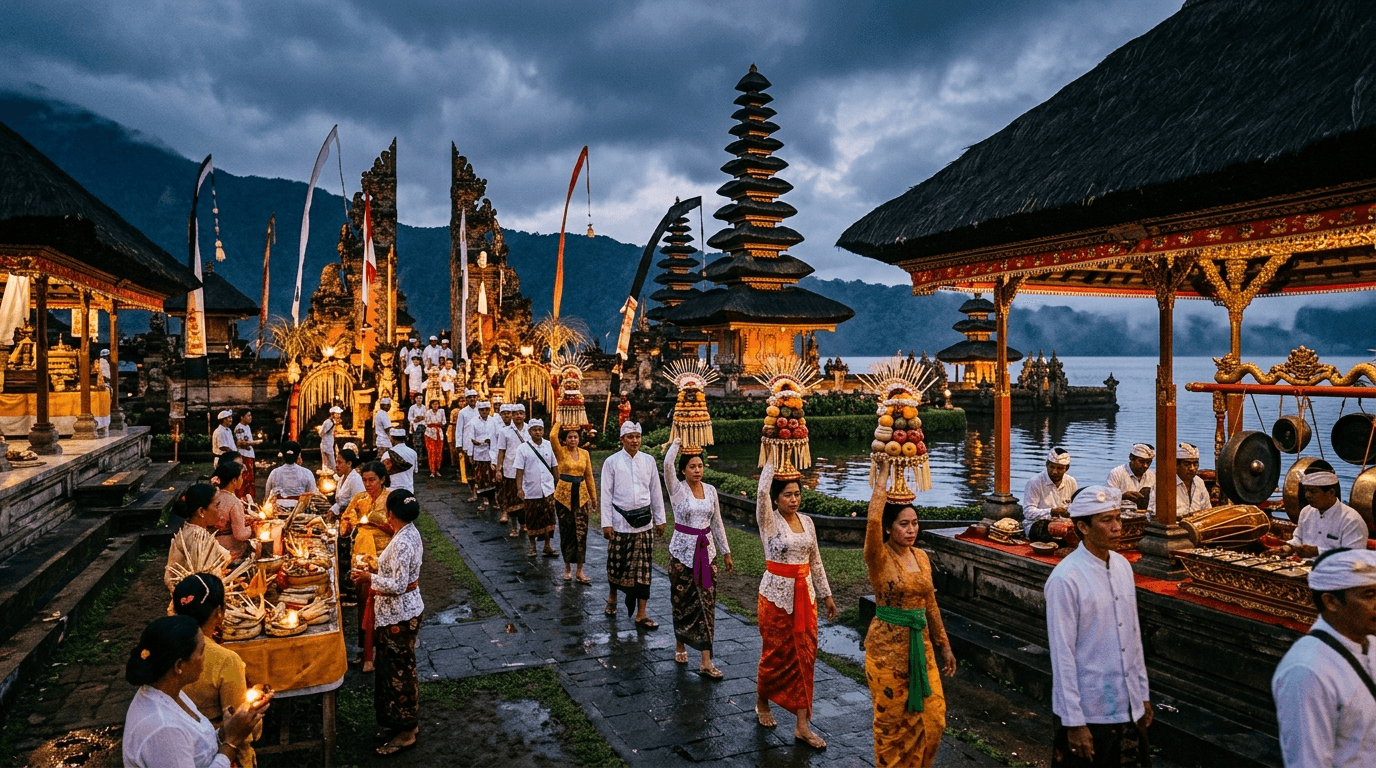
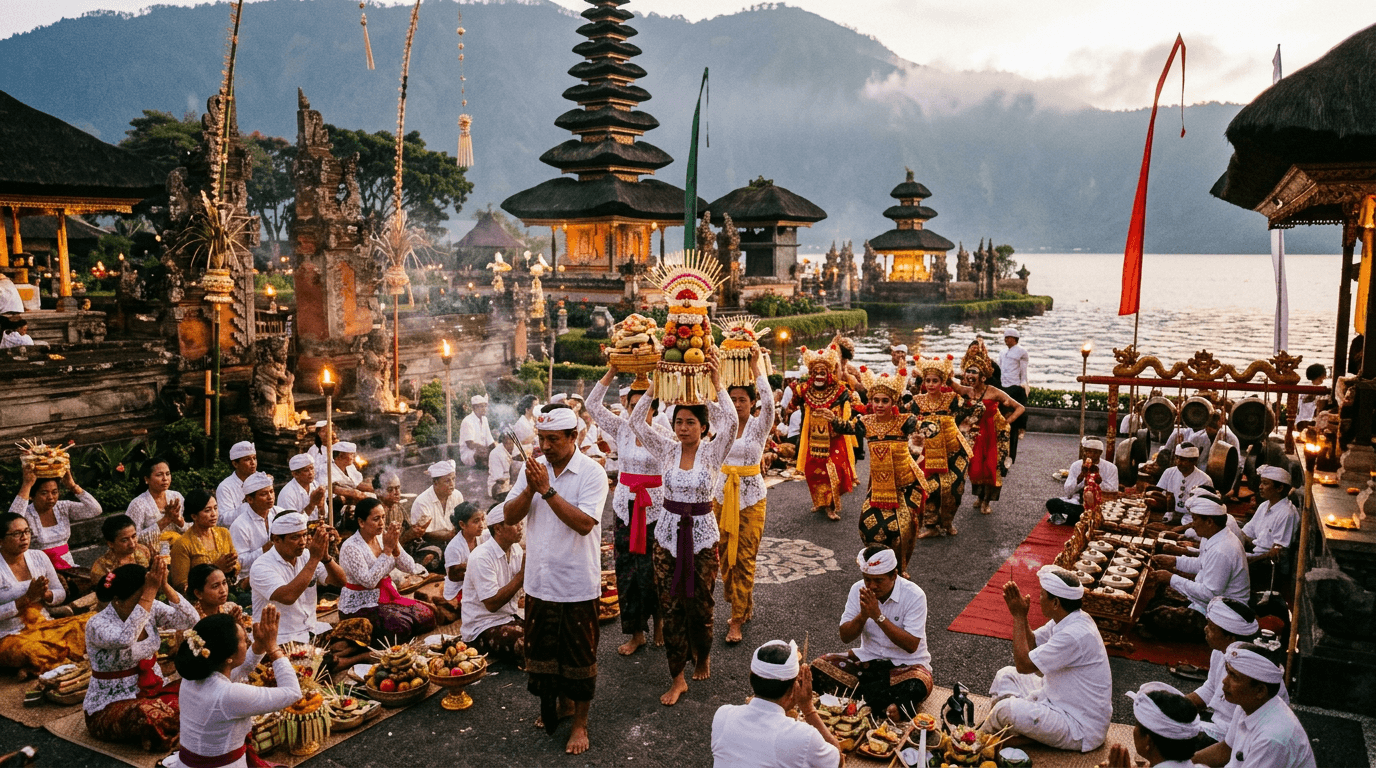
Threaded through every Subak is a hierarchy of water temples. At the top sits the great temple of Pura Ulun Danu Batur, associated with the crater lake of Mount Batur, the symbolic source of the island's water. Below it are regional temples, then temples for each Subak, and finally small shrines at individual weirs and field channels. Far from being decorative, these temples are the scheduling system of the entire island.
Priests and farmers use the ceremonial calendar to synchronise planting and fallow periods across hundreds of Subaks. When neighbouring fields flood and drain in coordinated waves, pests lose their habitat and water is used efficiently. Anthropologists who studied the network found that this ritual coordination produced rice yields and pest control that rivalled, and sometimes beat, modern centrally planned alternatives.
The Five UNESCO Sites
The Cultural Landscape of Bali Province inscribed by UNESCO spans several locations that together tell the story of Subak from mountain to field. They include the supreme water temple at Lake Batur, the lake itself, the famous terraces and temple network of the Pakerisan watershed near the ancient royal monuments, the Catur Angga Batukaru region surrounding the Batukaru volcano, and the sweeping terraces of Jatiluwih, one of the largest and most photographed Subak landscapes on the island.
- Pura Ulun Danu Batur and Lake Batur, the spiritual source of the island's water.
- The Subak landscape of the Pakerisan watershed, home to ancient carved temples.
- The Catur Angga Batukaru terraces on the slopes of the sacred Batukaru volcano.
- The expansive rice terraces of Jatiluwih, a highlight for visitors.
Why Subak Is Under Threat
A thousand-year-old system is now facing pressures it was never designed for. Tourism and population growth have driven up land prices, tempting farmers to sell paddies for villas and hotels. Once a field at the top of a Subak is paved over, the water channels feeding everyone below can be disrupted. Younger Balinese, drawn to better-paying jobs in hospitality, are less inclined to take on the hard, low-margin work of rice farming. Climate change and water demand from the booming south of the island add further strain.
UNESCO recognition brought attention and some protection, but it also brought tourists, and managing visitor impact at fragile sites is an ongoing challenge. The future of Subak depends on whether rice farming can remain economically viable for the communities that sustain it.
How to Experience Subak Respectfully
You do not need to be an anthropologist to appreciate Subak. Visit one of the heritage terraces such as Jatiluwih or Tegalalang and simply walk slowly, watching how the water steps down from field to field. Look for the small shrines at channel junctions and the bamboo pipes splitting the flow. Hiring a local guide, ideally a farmer, turns a photo stop into a genuine lesson in how the landscape works.
Treat the paddies as the working farms they are: stay on the paths, do not pick or trample rice, and ask before photographing people at work. Buying a coffee, a meal or local rice from terrace-side warungs puts money directly back into the communities keeping Subak alive. Entrance fees and donations at the heritage sites are modest and worth paying gladly. For current ticket prices and opening details it is always best to check the official site information locally, as these can change.
Subak endures because generations of Balinese decided that water was something to share rather than hoard. In a world increasingly anxious about water scarcity, this quiet, beautiful, deeply democratic system is not just a heritage relic. It is a lesson.